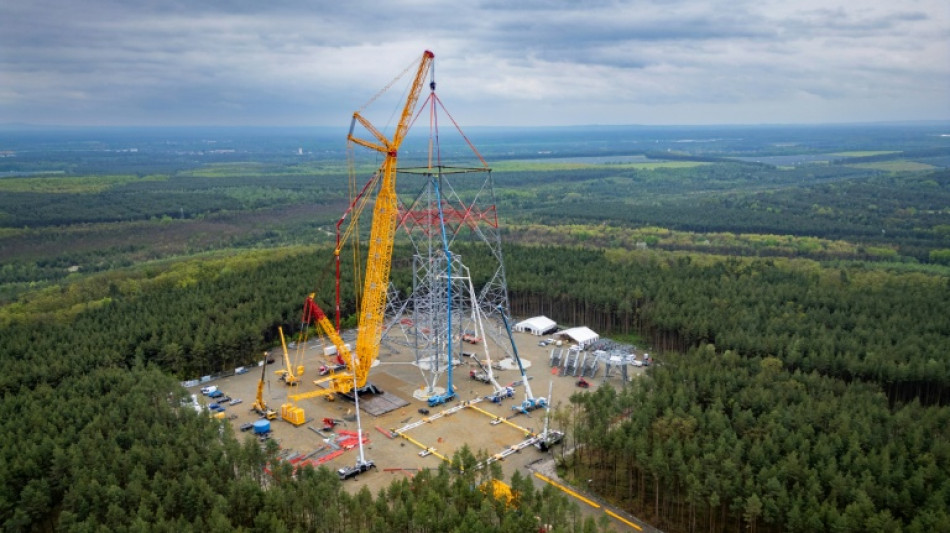
Giant wind turbine rises in Germany amid far-right headwinds / Photo: © AFP

 London
 17 °C
17 °C

 Manchester
17 °C
Manchester
17 °C
 Glasgow
 8 °C
8 °C
 Dublin
17 °C
Dublin
17 °C
 Belfast
16 °C
Belfast
16 °C
 Washington
23 °C
Washington
23 °C
 Denver
 26 °C
26 °C
 Atlanta
28 °C
Atlanta
28 °C
 Dallas
 30 °C
30 °C
 Houston Texas
31 °C
Houston Texas
31 °C
 New Orleans
30 °C
New Orleans
30 °C
 El Paso
27 °C
El Paso
27 °C
 Phoenix
26 °C
Phoenix
26 °C
 Los Angeles
19 °C
San Diego
20 °C
San Francisco
17 °C
Chicago
Los Angeles
19 °C
San Diego
20 °C
San Francisco
17 °C
Chicago
 29 °C
Minneapolis
24 °C
Seattle
12 °C
Portland
12 °C
Salt Lake City
29 °C
Minneapolis
24 °C
Seattle
12 °C
Portland
12 °C
Salt Lake City
 14 °C
Las Vegas
21 °C
Miami
32 °C
Jacksonville
30 °C
San Antonio
30 °C
Bermuda
29 °C
Nassau
21 °C
Iqaluit
-1 °C
Yellowknife
6 °C
Anchorage
5 °C
Fairbanks
2 °C
Barrow
-3 °C
Calgary
3 °C
Edmonton
28 °C
Winnipeg
6 °C
Goose Bay
17 °C
Halifax
19 °C
Boston
20 °C
Ottawa
16 °C
Toronto
20 °C
Detroit
24 °C
Cleveland
24 °C
New York
22 °C
Baltimore
23 °C
Philadelphia
22 °C
Nuuk (Godthåb)
5 °C
Hong Kong
14 °C
Las Vegas
21 °C
Miami
32 °C
Jacksonville
30 °C
San Antonio
30 °C
Bermuda
29 °C
Nassau
21 °C
Iqaluit
-1 °C
Yellowknife
6 °C
Anchorage
5 °C
Fairbanks
2 °C
Barrow
-3 °C
Calgary
3 °C
Edmonton
28 °C
Winnipeg
6 °C
Goose Bay
17 °C
Halifax
19 °C
Boston
20 °C
Ottawa
16 °C
Toronto
20 °C
Detroit
24 °C
Cleveland
24 °C
New York
22 °C
Baltimore
23 °C
Philadelphia
22 °C
Nuuk (Godthåb)
5 °C
Hong Kong
 26 °C
Singapore
26 °C
Singapore
 27 °C
Melbourne
29 °C
Canberra
15 °C
Adelaide
11 °C
Darwin
27 °C
Perth
15 °C
Fort Worth
29 °C
Honolulu
26 °C
Sydney
19 °C
Johannesburg
17 °C
Dubai
27 °C
Melbourne
29 °C
Canberra
15 °C
Adelaide
11 °C
Darwin
27 °C
Perth
15 °C
Fort Worth
29 °C
Honolulu
26 °C
Sydney
19 °C
Johannesburg
17 °C
Dubai
 33 °C
Mumbai
33 °C
Zürich
11 °C
Tokyo
19 °C
Seoul
20 °C
Delhi
24 °C
Beijing
13 °C
Riyadh
33 °C
Prague
10 °C
Pennsylvania
21 °C
Valletta
23 °C
Manama
32 °C
Warsaw
9 °C
Stockholm
7 °C
33 °C
Mumbai
33 °C
Zürich
11 °C
Tokyo
19 °C
Seoul
20 °C
Delhi
24 °C
Beijing
13 °C
Riyadh
33 °C
Prague
10 °C
Pennsylvania
21 °C
Valletta
23 °C
Manama
32 °C
Warsaw
9 °C
Stockholm
7 °C
A wind turbine billed as the world's tallest is rising in eastern Germany, winning praise as a beacon for a clean, green energy future and headwinds from the far-right AfD party.
The giant structure -- set to dwarf the Eiffel Tower at 365 metres (1,200 feet) once completed -- is going up in the former coal-mining region of Lusatia in Brandenburg state.
Once its huge rotor blades start spinning in the steady high-altitude winds before the end of the year, it is expected to generate enough electricity to power 7,500 households.
"We're achieving the same performance levels as an offshore wind farm, which means double the output compared to standard wind turbines," Jochen Grossmann, founder of the Dresden-based developer Gicon, told AFP during a visit to the site in a forest near the town of Schipkau.
As workers braved a cold rain, the structure doubled in height within a matter of hours, as 350 tonnes of steel were hoisted into place by huge yellow construction cranes.
The project is financed to the tune of 20-30 million euros through a government agency that sponsors cutting-edge tech, and seen by promoters as a new milestone in Germany's decades-old energy transition.
Europe's top economy has shuttered its nuclear plants and is phasing out coal while subsidising renewables, which last year generated almost 59 percent of electricity, about half of it through wind.
Grossmann sees such projects as the way forward if resource-poor Germany wants to meet its emissions targets and wean itself off fossil fuels from conflict-torn regions.
"For the time being, our only options are solar and wind power," he argued.
"Coal reserves are running out, and nuclear power has been phased out. We have only limited supplies of natural gas and oil.
"And at the moment, with the situation in the Strait of Hormuz and everything else, it's clear that we're also not independent when it comes to natural gas and oil."
- 'Windmills of shame' -
Not everyone shares Grossmann's enthusiasm.
The project is located in a stronghold region of the far-right Alternative for Germany (AfD), whose climate-sceptic leaders have decried the smaller "windmills of shame" that already dot the Schipkau area and much of Germany.
The loss of coal mining jobs has only fuelled local support for the AfD, which won nearly half the vote there in last year's parliamentary elections.
Birgit Bessin, an AfD member of the regional parliament, told AFP that turbines had effects on the local wildlife and suggested that nuclear energy would be a better alternative for emission-free power.
"When there are such fundamental impacts on residents, they should be consulted," she said, citing opposition from hunters and a local airfield.
The AfD also points to microplastics given off by wind turbines, although scientific studies have found no impact on human health.
- 'Get the public on board' -
While the AfD is adamantly opposed to wind power, Germany's year-old government under conservative Chancellor Friedrich Merz has also been less enthusiastic about renewables than the previous ruling coalition that included the Greens party.
Economy Minister Katherina Reiche has promised a wave of new gas power plants to compensate for renewables' intermittency, arguing this will help bring down German energy costs, among the highest in the world.
The German economy has been flatlining for years, in part because of soaring energy prices in the wake of Russia's 2022 full-scale invasion of Ukraine and the US-Israeli conflict with Iran that started in late February.
Outside the fences guarding the Schipkau site, local citizens sometimes come to have a look, some voicing anger about the project, Gicon staff said.
Klaus Prietzel, Schipkau's independent mayor, has floated the idea of the town taking over the turbine in the future to lower residents' energy bills.
Local authorities already share some of the gains from the existing windfarm, paying each resident 80 euros ($92) a year, usually just before Christmas.
"Our idea was that every citizen living in the municipality of Schipkau who can see the wind turbines should also benefit from them," said the mayor.
The AfD's Bessin dismissed such payments as "bribery", but Prietzel argued they are a useful.
"Around four million euros have already been paid out as part of a so-called acceptance-promoting measure," he said. "You have to get the public on board."
G.Miller--SFF