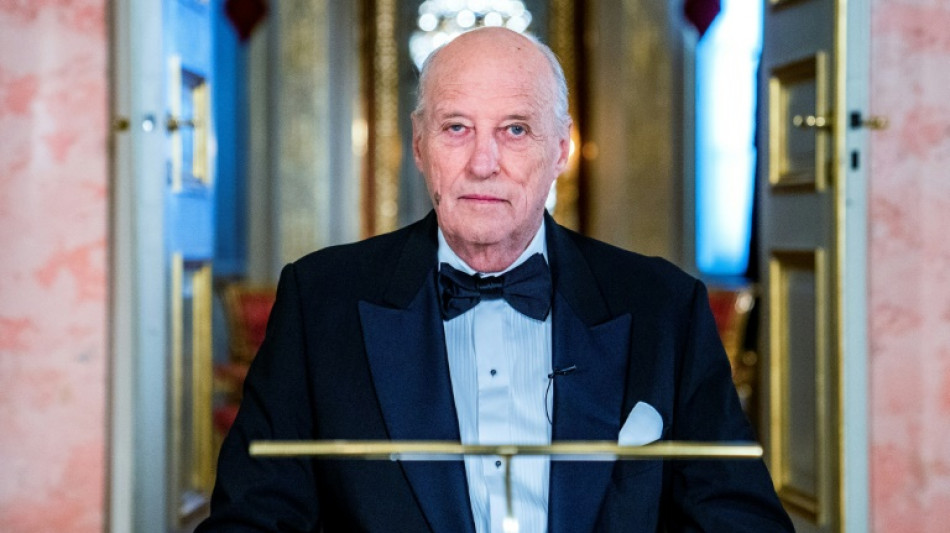
Norway's King Harald V, unifying force who weathered family storms / Photo: © NTB/AFP

 London
 11 °C
11 °C

 Manchester
 10 °C
10 °C
 Glasgow
 14 °C
14 °C
 Dublin
 9 °C
9 °C
 Belfast
8 °C
Belfast
8 °C
 Washington
 22 °C
22 °C
 Denver
16 °C
Denver
16 °C
 Atlanta
23 °C
Atlanta
23 °C
 Dallas
28 °C
Dallas
28 °C
 Houston Texas
 22 °C
22 °C
 New Orleans
25 °C
New Orleans
25 °C
 El Paso
 22 °C
22 °C
 Phoenix
27 °C
Phoenix
27 °C
 Los Angeles
23 °C
San Diego
23 °C
San Francisco
Los Angeles
23 °C
San Diego
23 °C
San Francisco
 17 °C
Chicago
20 °C
Minneapolis
17 °C
Chicago
20 °C
Minneapolis
 12 °C
Seattle
11 °C
Portland
12 °C
Salt Lake City
15 °C
Las Vegas
22 °C
Miami
27 °C
Jacksonville
24 °C
San Antonio
27 °C
Bermuda
25 °C
Nassau
15 °C
Iqaluit
-4 °C
Yellowknife
-1 °C
Anchorage
12 °C
Seattle
11 °C
Portland
12 °C
Salt Lake City
15 °C
Las Vegas
22 °C
Miami
27 °C
Jacksonville
24 °C
San Antonio
27 °C
Bermuda
25 °C
Nassau
15 °C
Iqaluit
-4 °C
Yellowknife
-1 °C
Anchorage
 0 °C
Fairbanks
1 °C
Barrow
-4 °C
Calgary
3 °C
Edmonton
24 °C
Winnipeg
5 °C
Goose Bay
8 °C
Halifax
12 °C
Boston
13 °C
Ottawa
7 °C
Toronto
10 °C
Detroit
16 °C
Cleveland
19 °C
New York
17 °C
Baltimore
20 °C
Philadelphia
19 °C
Nuuk (Godthåb)
-2 °C
Hong Kong
26 °C
Singapore
28 °C
Melbourne
27 °C
Canberra
3 °C
Adelaide
9 °C
Darwin
26 °C
Perth
17 °C
Fort Worth
27 °C
Honolulu
25 °C
Sydney
14 °C
Johannesburg
21 °C
Dubai
0 °C
Fairbanks
1 °C
Barrow
-4 °C
Calgary
3 °C
Edmonton
24 °C
Winnipeg
5 °C
Goose Bay
8 °C
Halifax
12 °C
Boston
13 °C
Ottawa
7 °C
Toronto
10 °C
Detroit
16 °C
Cleveland
19 °C
New York
17 °C
Baltimore
20 °C
Philadelphia
19 °C
Nuuk (Godthåb)
-2 °C
Hong Kong
26 °C
Singapore
28 °C
Melbourne
27 °C
Canberra
3 °C
Adelaide
9 °C
Darwin
26 °C
Perth
17 °C
Fort Worth
27 °C
Honolulu
25 °C
Sydney
14 °C
Johannesburg
21 °C
Dubai
 30 °C
Mumbai
30 °C
Zürich
11 °C
Tokyo
16 °C
Seoul
4 °C
Delhi
20 °C
Beijing
0 °C
Riyadh
27 °C
Prague
9 °C
Pennsylvania
19 °C
Valletta
20 °C
Manama
32 °C
Warsaw
6 °C
Stockholm
11 °C
30 °C
Mumbai
30 °C
Zürich
11 °C
Tokyo
16 °C
Seoul
4 °C
Delhi
20 °C
Beijing
0 °C
Riyadh
27 °C
Prague
9 °C
Pennsylvania
19 °C
Valletta
20 °C
Manama
32 °C
Warsaw
6 °C
Stockholm
11 °C
King Harald V of Norway, who died on Friday aged 89, remained a unifying figure in his country until the very end, a pillar of stability amid a string of family scandals that tarnished the final years of his reign.
On the throne since 1991, Europe's oldest reigning monarch suffered from increasing health problems in his later years, but adamantly refused to abdicate.
He was again hospitalised on August 17 in Oslo due to complications from the blood condition haemolytic anaemia, and the royal palace announced his death on Friday.
Despite limited powers as head of state, the king inspired unity in Norway, always managing to find the right thing to say in difficult times.
One such instance was after the neo-Nazi Anders Behring Breivik claimed 77 lives in twin attacks on July 22, 2011, in Norway's worst massacre since World War II.
"I firmly believe that freedom is stronger than fear. I firmly believe in an open Norwegian democracy and society," Harald said at the time.
The king also took the Scandinavian country's progressive values to heart, which he stressed in a speech marking his 25th year as monarch in 2016.
"Norwegians are girls who love girls, boys who love boys, and girls and boys who love each other," he said, adding: "Norwegians believe in God, Allah, the Universe and nothing."
- To his dying breath -
Unlike other European royals, such as Juan Carlos in Spain, Albert II in Belgium, Beatrix in the Netherlands and his distant cousin Margrethe II in Denmark, who all gave up the throne during their lifetimes, King Harald made it clear he intended to reign until his last breath.
"The oath I've sworn before parliament lasts as long as my life, that's how simple it is," he said repeatedly.
Like many of his subjects, King Harald loved the outdoors and was fond of fishing, hunting and skiing.
An accomplished sportsman -- he represented Norway three times at the Olympics in sailing -- he cut a tall and stocky figure, his austere looks hiding a biting sense of humour.
But he battled mounting health issues over the years.
He underwent surgery for bladder cancer in 2003 and on his heart two years later, he walked with crutches in his final years, was fitted with a pacemaker in 2024, and was repeatedly hospitalised.
Harald was born in 1937.
Three years later, the Nazis invaded Norway, and in April 1940 the future king was evacuated, first to Sweden and then to the United States.
He lived in Washington with his mother, Princess Martha, throughout the rest of World War II while his father, Prince Olav, lived in London with King Haakon.
He returned to Norway when peace came, living as normal a life as possible for a royal.
The end of his reign was marred by a series of scandals which, much to his dismay, damaged the monarchy's reputation.
In 2024, his daughter Martha-Louise, a fan of alternative healing, made headlines when she married a self-professed American shaman.
In January 2026, the release of a cache of Epstein files uncovered the hitherto-unknown close friendship between the convicted sex offender and Crown Princess Mette-Marit, wife of the heir to the throne, Crown Prince Haakon.
Several months later, Mette-Marit's son from a previous relationship, Marius Borg Hoiby, was sentenced to four years in prison by an Oslo court for rape and assault, which he has appealed.
While he has no formal role in the royal family, his legal troubles dragged the monarchy into its biggest ever scandal.
- 'Pain and adversity' -
The king has remained measured amidst the family's turmoil.
"At the core of being human lies the fact that none of us is spared from pain and adversity," Harald said in a 2025 New Year's speech.
While the king himself stayed extremely popular to the end -- highly appreciated for his unassuming, modest lifestyle -- the scandals hurt the monarchy's popularity.
A February 2026 opinion poll published by broadcaster NRK showed only 60 percent of Norwegians supported the institution, a level that had "never been so low".
Like his children, Harald married a commoner, Sonja Haraldsen.
But prior to the pair's 1968 engagement, they faced nine years of opposition before winning the approval of Harald's father King Olav and parts of the ruling class.
That bitter memory may be why he allowed his children to marry commoners -- a choice that would later put the monarchy to the test.
P.Adams--SFF