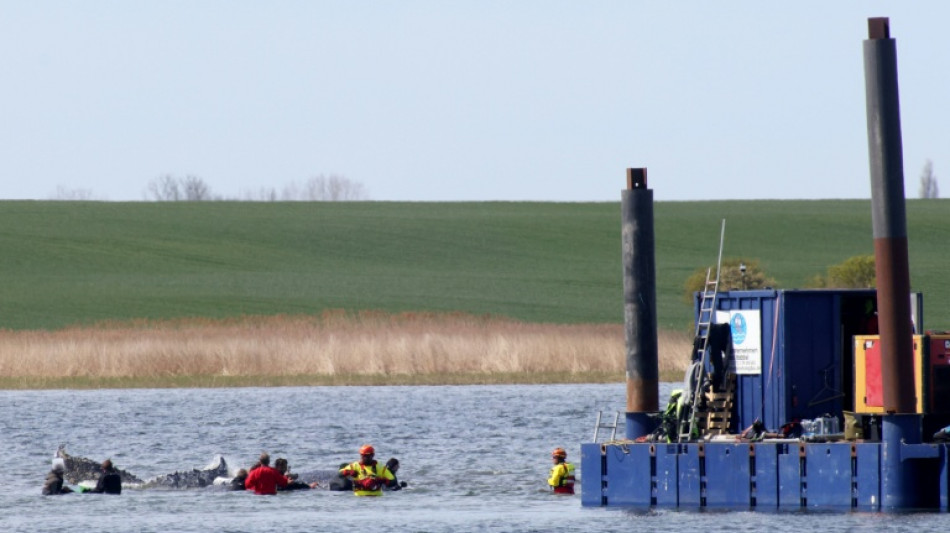
Germany holds breath as stranded whale 'Timmy' sets off in barge / Photo: © AFP

 London
 18 °C
18 °C

 Manchester
15 °C
Manchester
15 °C
 Glasgow
 16 °C
16 °C
 Dublin
17 °C
Dublin
17 °C
 Belfast
16 °C
Belfast
16 °C
 Washington
31 °C
Washington
31 °C
 Denver
 22 °C
22 °C
 Atlanta
32 °C
Atlanta
32 °C
 Dallas
 36 °C
36 °C
 Houston Texas
32 °C
Houston Texas
32 °C
 New Orleans
32 °C
New Orleans
32 °C
 El Paso
31 °C
El Paso
31 °C
 Phoenix
37 °C
Phoenix
37 °C
 Los Angeles
36 °C
San Diego
34 °C
San Francisco
27 °C
Chicago
24 °C
Minneapolis
26 °C
Seattle
19 °C
Portland
21 °C
Salt Lake City
25 °C
Las Vegas
35 °C
Miami
Los Angeles
36 °C
San Diego
34 °C
San Francisco
27 °C
Chicago
24 °C
Minneapolis
26 °C
Seattle
19 °C
Portland
21 °C
Salt Lake City
25 °C
Las Vegas
35 °C
Miami
 30 °C
Jacksonville
32 °C
San Antonio
33 °C
Bermuda
28 °C
Nassau
27 °C
Iqaluit
8 °C
Yellowknife
17 °C
Anchorage
11 °C
Fairbanks
9 °C
Barrow
2 °C
Calgary
22 °C
Edmonton
33 °C
Winnipeg
20 °C
Goose Bay
19 °C
Halifax
26 °C
Boston
25 °C
Ottawa
18 °C
Toronto
22 °C
Detroit
24 °C
Cleveland
31 °C
New York
29 °C
Baltimore
31 °C
Philadelphia
30 °C
Nuuk (Godthåb)
6 °C
Hong Kong
28 °C
Singapore
29 °C
Melbourne
31 °C
Canberra
30 °C
Jacksonville
32 °C
San Antonio
33 °C
Bermuda
28 °C
Nassau
27 °C
Iqaluit
8 °C
Yellowknife
17 °C
Anchorage
11 °C
Fairbanks
9 °C
Barrow
2 °C
Calgary
22 °C
Edmonton
33 °C
Winnipeg
20 °C
Goose Bay
19 °C
Halifax
26 °C
Boston
25 °C
Ottawa
18 °C
Toronto
22 °C
Detroit
24 °C
Cleveland
31 °C
New York
29 °C
Baltimore
31 °C
Philadelphia
30 °C
Nuuk (Godthåb)
6 °C
Hong Kong
28 °C
Singapore
29 °C
Melbourne
31 °C
Canberra
 2 °C
Adelaide
9 °C
Darwin
25 °C
Perth
15 °C
Fort Worth
36 °C
Honolulu
24 °C
Sydney
10 °C
Johannesburg
14 °C
Dubai
38 °C
Mumbai
2 °C
Adelaide
9 °C
Darwin
25 °C
Perth
15 °C
Fort Worth
36 °C
Honolulu
24 °C
Sydney
10 °C
Johannesburg
14 °C
Dubai
38 °C
Mumbai
 29 °C
Zürich
15 °C
Tokyo
29 °C
Zürich
15 °C
Tokyo
 19 °C
Seoul
17 °C
Delhi
30 °C
Beijing
13 °C
Riyadh
39 °C
Prague
17 °C
Pennsylvania
29 °C
Valletta
29 °C
Manama
37 °C
Warsaw
25 °C
Stockholm
16 °C
19 °C
Seoul
17 °C
Delhi
30 °C
Beijing
13 °C
Riyadh
39 °C
Prague
17 °C
Pennsylvania
29 °C
Valletta
29 °C
Manama
37 °C
Warsaw
25 °C
Stockholm
16 °C
A special boat carrying a stranded humpback whale whose weeks-long struggle to survive has captured hearts in Germany set off for the open seas on Tuesday evening in a last-ditch rescue attempt.
Rescuers had earlier succeeded in coaxing the animal into the barge, which has a water-filled hold and is usually used to carry other boats, in an attempt to return it to its natural habitat.
The whale, dubbed "Timmy" by German media, and its ordeal have gripped the country since it beached on a sandbank in late March near the city of Luebeck on the Baltic Sea coast, far from its natural home in the Atlantic Ocean.
The latest rescue effort -- financed by two entrepreneurs -- was seen as a long shot and has been criticised by experts who said it would only cause the animal more distress.
But the plan looked like it could beat the odds as the barge set off from the island of Poel, live images showed.
Earlier, rescuers attached straps to the whale and heaved the creature down a channel that had been specially dug in the sand to allow it to reach the barge.
After some distance, the whale, with rescuers swimming alongside it, sped up and then swam into the barge, sparking cheers of delight from the rescue team and others watching from the shore.
"I can't even say how happy I am," Karin Walter-Mommert, one of the entrepreneurs financing the rescue bid, told newspaper Bild.
"You could see that the whale fought and wanted to live. Knowing he's now in the barge is simply wonderful and shows that the fight for Timmy was worth it."
- Fighting the odds -
The plan is now for the barge to be transported to the North Sea, and for the whale to be released if it is strong enough.
A piece of green netting is being used to close the entrance to the barge so the whale does not swim out.
Till Backhaus, environment minister for the state of Mecklenburg-Western Pomerania, earlier told reporters: "We have worked here day and night, and in the end we have saved this animal."
Backhaus gave the green light for the mission to proceed after vets said the whale was fit to be transported.
The animal was first spotted stuck on a sandbank on March 23 before freeing itself and then becoming stuck again several times.
Various attempts were initially made to free it, including by digging channels for it to swim down, but all failed.
At the start of April, officials gave up on trying to rescue the whale, saying they believed it could not be saved.
But this triggered an outcry and authorities were persuaded to let the entrepreneurs come up with a rescue plan.
The barge idea was hatched after their initial attempt to save the whale with inflatable cushions and pontoons was unsuccessful.
Some scientists had strongly criticised the decision to allow further rescue bids, believing they would be too risky for the whale and estimating the chances of success as low.
- 'Definitely worth it' -
Backhaus defended the rescue, saying it was "definitely worth it".
"I've always said, those who do nothing make no mistakes," he added.
If only the "scientists (who) said it was all pointless... had seen the young (whale) now, how he swam into the barge all by himself", he told reporters.
Backhaus also defended himself against criticism in a written statement, insisting that "in making our decisions, we have always relied on science".
"No one could tell us with certainty that the whale would die, and when. On the basis of these vague statements, we decided to tolerate the rescue attempt," he said.
The saga has sparked a media frenzy -- with non-stop coverage from TV channels, online outlets and social media influencers -- but has also led to angry spats and conspiracy theories.
E.Walker--SFF