Nobel winner Halzen says years of October 'misery' finally over / Photo: © AFP

 London
 19 °C
19 °C

 Manchester
17 °C
Manchester
17 °C
 Glasgow
15 °C
Glasgow
15 °C
 Dublin
 12 °C
12 °C
 Belfast
12 °C
Belfast
12 °C
 Washington
 18 °C
18 °C
 Denver
 29 °C
29 °C
 Atlanta
25 °C
Atlanta
25 °C
 Dallas
29 °C
Dallas
29 °C
 Houston Texas
31 °C
Houston Texas
31 °C
 New Orleans
26 °C
New Orleans
26 °C
 El Paso
25 °C
El Paso
25 °C
 Phoenix
34 °C
Phoenix
34 °C
 Los Angeles
35 °C
San Diego
35 °C
San Francisco
22 °C
Chicago
22 °C
Minneapolis
Los Angeles
35 °C
San Diego
35 °C
San Francisco
22 °C
Chicago
22 °C
Minneapolis
 23 °C
Seattle
15 °C
Portland
17 °C
Salt Lake City
22 °C
Las Vegas
31 °C
Miami
32 °C
Jacksonville
23 °C
Seattle
15 °C
Portland
17 °C
Salt Lake City
22 °C
Las Vegas
31 °C
Miami
32 °C
Jacksonville
 24 °C
San Antonio
30 °C
Bermuda
27 °C
Nassau
15 °C
Iqaluit
2 °C
Yellowknife
6 °C
Anchorage
5 °C
Fairbanks
0 °C
Barrow
-5 °C
Calgary
17 °C
Edmonton
24 °C
Winnipeg
19 °C
Goose Bay
11 °C
Halifax
16 °C
Boston
16 °C
Ottawa
12 °C
Toronto
13 °C
Detroit
19 °C
Cleveland
18 °C
New York
16 °C
Baltimore
17 °C
Philadelphia
16 °C
Nuuk (Godthåb)
3 °C
Hong Kong
26 °C
Singapore
24 °C
San Antonio
30 °C
Bermuda
27 °C
Nassau
15 °C
Iqaluit
2 °C
Yellowknife
6 °C
Anchorage
5 °C
Fairbanks
0 °C
Barrow
-5 °C
Calgary
17 °C
Edmonton
24 °C
Winnipeg
19 °C
Goose Bay
11 °C
Halifax
16 °C
Boston
16 °C
Ottawa
12 °C
Toronto
13 °C
Detroit
19 °C
Cleveland
18 °C
New York
16 °C
Baltimore
17 °C
Philadelphia
16 °C
Nuuk (Godthåb)
3 °C
Hong Kong
26 °C
Singapore
 29 °C
Melbourne
29 °C
Canberra
7 °C
Adelaide
11 °C
Darwin
26 °C
Perth
17 °C
Fort Worth
29 °C
Honolulu
23 °C
Sydney
15 °C
Johannesburg
17 °C
Dubai
35 °C
Mumbai
30 °C
Zürich
29 °C
Melbourne
29 °C
Canberra
7 °C
Adelaide
11 °C
Darwin
26 °C
Perth
17 °C
Fort Worth
29 °C
Honolulu
23 °C
Sydney
15 °C
Johannesburg
17 °C
Dubai
35 °C
Mumbai
30 °C
Zürich
 18 °C
Tokyo
21 °C
Seoul
10 °C
Delhi
29 °C
Beijing
8 °C
Riyadh
34 °C
Prague
17 °C
Pennsylvania
16 °C
Valletta
18 °C
Tokyo
21 °C
Seoul
10 °C
Delhi
29 °C
Beijing
8 °C
Riyadh
34 °C
Prague
17 °C
Pennsylvania
16 °C
Valletta
 25 °C
Manama
32 °C
Warsaw
16 °C
Stockholm
13 °C
25 °C
Manama
32 °C
Warsaw
16 °C
Stockholm
13 °C
Physicist Francis Halzen has an impressively long list of academic accolades -- but every October, as the Nobel Prize rolled around, his failure to bag the biggest award of them all left him "miserable," he admits.
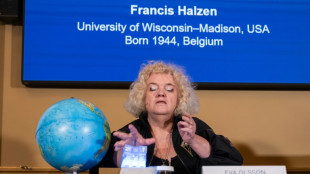
"It's a great relief for me, because this was not totally unexpected," he told a press conference Tuesday at the University of Wisconsin–Madison, where he serves as a professor. He spoke by video from a hotel room in Italy where he was attending a scientific meeting.
"Around this time of the year, I always felt miserable because I didn't win the prize, and thought... it was terrible for my collaborators who deserved it so much, and that I disappointed the whole IceCube collaboration every October," he added. "So that problem is finally solved. I'm very grateful for it."
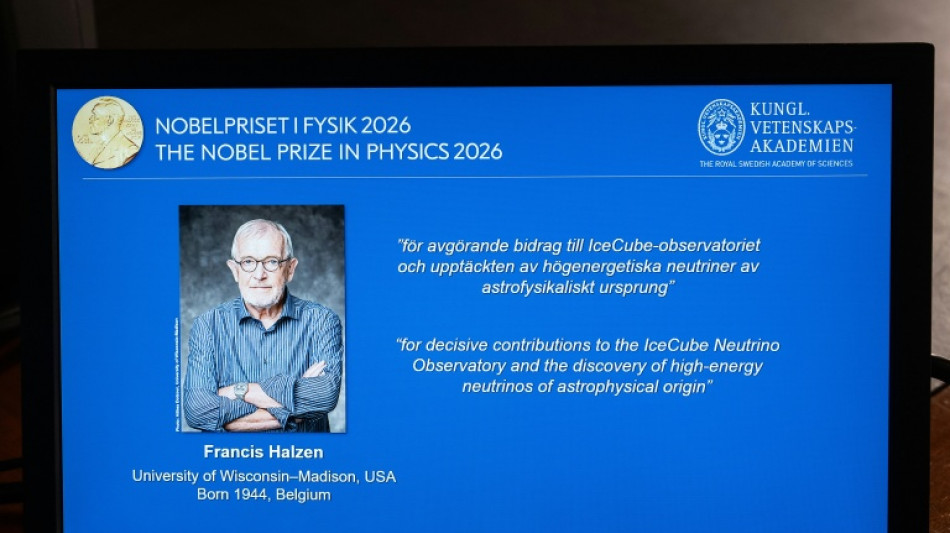
The 82-year-old is the brains behind the IceCube Neutrino Observatory, a telescope embedded in a cubic kilometer of Antarctic ice that detects neutrinos -- particles with almost no mass that seldom interact with other matter.
Every second, about 65 billion neutrinos from the Sun pass through your little fingernail. Those from deeper in space carry clues about cosmic mysteries, like the supermassive black holes at the heart of galaxies.
Halzen, who grew up in Belgium, paid rich tribute to the roughly 450 people across more than a dozen countries who have helped turn an idea he conceived in the late 1980s into reality.
"UW took incredible risks on this project," he said of his university. "We had several milestones we had to pass, and at each point, this project could have failed."
He also thanked the National Science Foundation (NSF) for taking a chance on the project, "which in retrospect amazes me, I am not sure this could happen today, but it happened, and we were very lucky."
President Donald Trump's administration has called for deep cuts to the NSF, the US agency that funds fundamental research, and directed it to focus on the administration's technology priorities.
Physicists before Halzen had suggested water could capture neutrinos from space: when a neutrino hits an atomic nucleus, it produces a charged particle that travels in the same direction and emits blue light, which can be detected because water is transparent.
Halzen's great leap was to use ice instead -- unlike liquid water, it isn't disturbed by living creatures, and its darkness is constant at great depth.
Making it work was a struggle, but the first neutrino images, captured by an R&D precursor to IceCube, were "the greatest excitement I ever felt about this project," he said. "It was just incredible. It was the fact that we could make this work."
IceCube has been fully operational since 2011 and has detected high-energy neutrinos from a distant galaxy in the direction of the constellation Orion, as well as from our own Milky Way.
As for the future, Halzen noted that whenever humanity has opened a new "window on the universe," predictions about what would follow have proven wrong.
"What this will bring is impossible to predict, but it has always been great in the past, and there is no reason not to think that it will be great again."
V.Perez--SFF