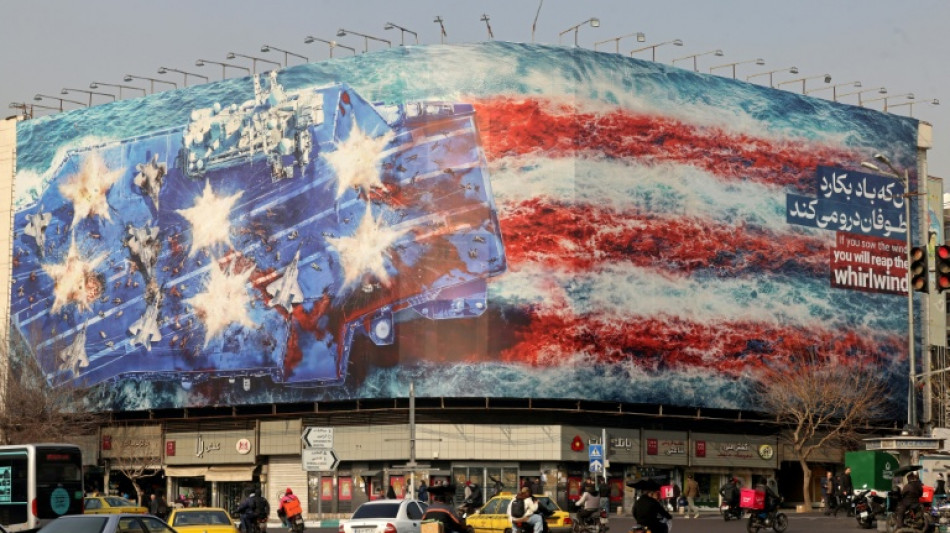
Iran rejects talks with US amid military 'threats' / Photo: © AFP

 London
 14 °C
14 °C

 Manchester
13 °C
Manchester
13 °C
 Glasgow
14 °C
Glasgow
14 °C
 Dublin
 12 °C
12 °C
 Belfast
 12 °C
12 °C
 Washington
 12 °C
12 °C
 Denver
8 °C
Denver
8 °C
 Atlanta
13 °C
Atlanta
13 °C
 Dallas
11 °C
Dallas
11 °C
 Houston Texas
14 °C
Houston Texas
14 °C
 New Orleans
14 °C
New Orleans
14 °C
 El Paso
 7 °C
7 °C
 Phoenix
21 °C
Phoenix
21 °C
 Los Angeles
23 °C
San Diego
26 °C
San Francisco
17 °C
Chicago
7 °C
Minneapolis
6 °C
Seattle
14 °C
Portland
12 °C
Salt Lake City
10 °C
Las Vegas
16 °C
Miami
30 °C
Jacksonville
20 °C
San Antonio
13 °C
Bermuda
27 °C
Nassau
10 °C
Iqaluit
-9 °C
Yellowknife
4 °C
Anchorage
3 °C
Fairbanks
0 °C
Barrow
Los Angeles
23 °C
San Diego
26 °C
San Francisco
17 °C
Chicago
7 °C
Minneapolis
6 °C
Seattle
14 °C
Portland
12 °C
Salt Lake City
10 °C
Las Vegas
16 °C
Miami
30 °C
Jacksonville
20 °C
San Antonio
13 °C
Bermuda
27 °C
Nassau
10 °C
Iqaluit
-9 °C
Yellowknife
4 °C
Anchorage
3 °C
Fairbanks
0 °C
Barrow
 -2 °C
Calgary
6 °C
Edmonton
10 °C
Winnipeg
3 °C
Goose Bay
3 °C
Halifax
8 °C
Boston
9 °C
Ottawa
3 °C
Toronto
4 °C
Detroit
7 °C
Cleveland
9 °C
New York
10 °C
Baltimore
12 °C
Philadelphia
10 °C
Nuuk (Godthåb)
1 °C
Hong Kong
-2 °C
Calgary
6 °C
Edmonton
10 °C
Winnipeg
3 °C
Goose Bay
3 °C
Halifax
8 °C
Boston
9 °C
Ottawa
3 °C
Toronto
4 °C
Detroit
7 °C
Cleveland
9 °C
New York
10 °C
Baltimore
12 °C
Philadelphia
10 °C
Nuuk (Godthåb)
1 °C
Hong Kong
 28 °C
Singapore
29 °C
Melbourne
27 °C
Canberra
9 °C
Adelaide
21 °C
Darwin
28 °C
Perth
28 °C
Singapore
29 °C
Melbourne
27 °C
Canberra
9 °C
Adelaide
21 °C
Darwin
28 °C
Perth
 18 °C
Fort Worth
10 °C
Honolulu
18 °C
Fort Worth
10 °C
Honolulu
 25 °C
Sydney
14 °C
Johannesburg
31 °C
Dubai
33 °C
Mumbai
32 °C
Zürich
12 °C
Tokyo
19 °C
Seoul
21 °C
Delhi
26 °C
Beijing
17 °C
Riyadh
35 °C
Prague
16 °C
Pennsylvania
9 °C
Valletta
24 °C
Manama
34 °C
Warsaw
13 °C
Stockholm
9 °C
25 °C
Sydney
14 °C
Johannesburg
31 °C
Dubai
33 °C
Mumbai
32 °C
Zürich
12 °C
Tokyo
19 °C
Seoul
21 °C
Delhi
26 °C
Beijing
17 °C
Riyadh
35 °C
Prague
16 °C
Pennsylvania
9 °C
Valletta
24 °C
Manama
34 °C
Warsaw
13 °C
Stockholm
9 °C
Iran on Wednesday rejected holding negotiations with the United States if it makes threats against the Islamic republic, after President Donald Trump refused to rule out military intervention over its deadly crackdown on protests.
With a US naval strike group led by an aircraft carrier lurking in Middle East waters, top Iranian officials also reached out to key Arab states in behind-the-scenes diplomacy to rally support.
A rights group said that it has verified over 6,200 deaths, mostly of protesters killed by security forces, in the wave of demonstrations that rocked the clerical leadership since late December but peaked on January 8-9.
Activists say that the actual toll could be many times higher with an internet shutdown still complicating efforts to confirm information about the scale of the killings.
Trump has not ruled out military action against Iran in response to the crackdown, while appearing to keep his options open. A strike group led by the USS Abraham Lincoln has now arrived in Middle Eastern waters, US Central Command said, without revealing its precise location.
Analysts say options include strikes on military facilities or targeted hits against the leadership under Ayatollah Ali Khamenei in a full-scale bid to bring down the system that has ruled Iran since the 1979 Islamic revolution that ousted the shah.
- 'Reducing escalation' -
But Foreign Minister Abbas Araghchi said "conducting diplomacy through military threat cannot be effective or useful".
"If they want negotiations to take shape, they must certainly set aside threats, excessive demands and raising illogical issues," he said in televised comments.
Araghchi said he in recent days he had "no contact" with US Middle East envoy Steve Witkoff and that "Iran has not sought negotiations".
Following a call on Tuesday between Iranian President Masoud Pezeshkian and de facto Saudi leader Crown Prince Mohammed bin Salman, Iran reached out to other Arab states allied to the United States in an apparent bid to rally support.
The Secretary of Iran's Supreme National Security Council Ali Larijani spoke with Qatari Prime Minister Sheikh Mohammed bin Abdulrahman Al Thani, who is also foreign minister, both sides said.
Sheikh Mohammed emphasised Qatar's support for "all efforts aimed at reducing escalation and achieving peaceful solutions in a manner that enhances security and stability in the region", the Qatari foreign ministry said.
Egyptian Foreign Minister Badr Abdelatty meanwhile held separate calls with both Araghchi and Witkoff, Cairo said.
Abdelatty stressed the need to intensify efforts to "ease tensions and work towards deescalation" and create the "necessary conditions to resume dialogue between the US and Iran", the Egyptian foreign ministry said.
New billboards have meanwhile appeared in Tehran showing Iran striking an American aircraft carrier and also slogans of Khamenei denouncing the US, according to AFP journalists.
- 'New dimensions of crackdown' -
In an updated toll, the US-based Human Rights Activists News Agency (HRANA) said it had confirmed that 6,221 people had been killed, including 5,856 protesters, 100 minors, 214 members of the security forces and 49 bystanders.
But the group, which has an extensive network of sources inside Iran and has tracked the protests on a daily basis since they began, added it was still investigating another 17,091 possible fatalities.
At least 42,324 people have been arrested, it said.
HRANA warned that the crackdown was continuing with security forces searching hospitals for wounded protesters, doctors who helped protesters arrested, and "forced confessions" broadcast on state television.
These developments "highlight new dimensions of the continued security crackdown in the aftermath of the protests".
Meanwhile, Iran on Wednesday executed a man arrested in April 2025 on charges of spying for Israel's espionage agency Mossad, the judiciary said.
Rights groups have previously said 12 people have been hanged on similar charges in the wake of Israel's 12-day war with Iran in June.
They have expressed concern that protesters could also face execution. The judiciary has already indicated some of those arrested could face charges of capital crimes.
L.Nguyen--SFF