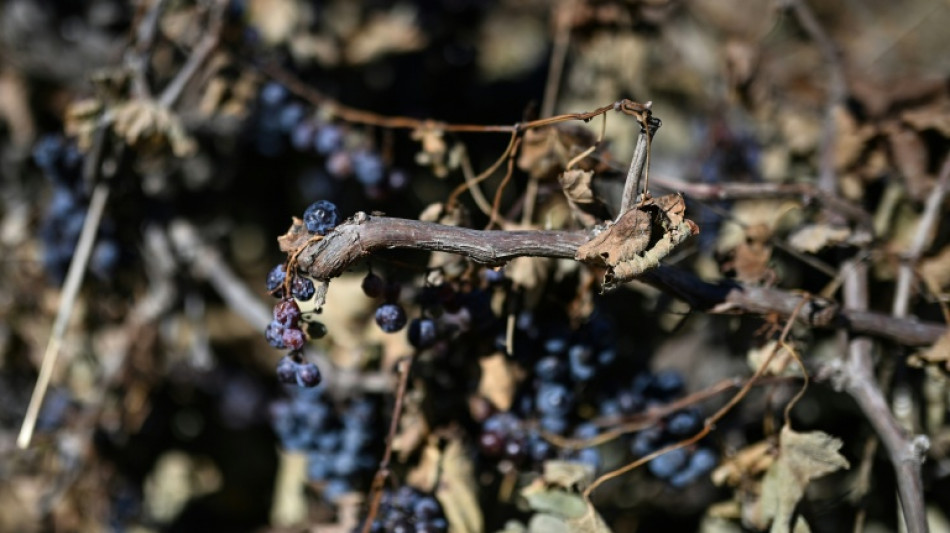
French wine harvest set to hit historic low / Photo: © AFP/File

 London
 13 °C
13 °C
 Manchester
 14 °C
14 °C
 Glasgow
 21 °C
21 °C
 Dublin
13 °C
Dublin
13 °C
 Belfast
12 °C
Belfast
12 °C
 Washington
14 °C
Washington
14 °C
 Denver
16 °C
Denver
16 °C
 Atlanta
17 °C
Atlanta
17 °C
 Dallas
20 °C
Dallas
20 °C
 Houston Texas
25 °C
Houston Texas
25 °C
 New Orleans
25 °C
New Orleans
25 °C
 El Paso
17 °C
El Paso
17 °C
 Phoenix
27 °C
Phoenix
27 °C
 Los Angeles
24 °C
San Diego
21 °C
San Francisco
Los Angeles
24 °C
San Diego
21 °C
San Francisco
 16 °C
Chicago
17 °C
Minneapolis
14 °C
Seattle
16 °C
Chicago
17 °C
Minneapolis
14 °C
Seattle
 12 °C
Portland
11 °C
Salt Lake City
16 °C
Las Vegas
23 °C
Miami
29 °C
Jacksonville
22 °C
San Antonio
22 °C
Bermuda
24 °C
Nassau
16 °C
Iqaluit
0 °C
Yellowknife
1 °C
Anchorage
12 °C
Portland
11 °C
Salt Lake City
16 °C
Las Vegas
23 °C
Miami
29 °C
Jacksonville
22 °C
San Antonio
22 °C
Bermuda
24 °C
Nassau
16 °C
Iqaluit
0 °C
Yellowknife
1 °C
Anchorage
 6 °C
Fairbanks
6 °C
Fairbanks
 0 °C
Barrow
-6 °C
Calgary
4 °C
Edmonton
19 °C
Winnipeg
10 °C
Goose Bay
13 °C
Halifax
13 °C
Boston
12 °C
Ottawa
10 °C
Toronto
16 °C
Detroit
16 °C
Cleveland
16 °C
New York
15 °C
Baltimore
15 °C
Philadelphia
15 °C
Nuuk (Godthåb)
2 °C
Hong Kong
0 °C
Barrow
-6 °C
Calgary
4 °C
Edmonton
19 °C
Winnipeg
10 °C
Goose Bay
13 °C
Halifax
13 °C
Boston
12 °C
Ottawa
10 °C
Toronto
16 °C
Detroit
16 °C
Cleveland
16 °C
New York
15 °C
Baltimore
15 °C
Philadelphia
15 °C
Nuuk (Godthåb)
2 °C
Hong Kong
 26 °C
Singapore
30 °C
Melbourne
26 °C
Canberra
6 °C
Adelaide
17 °C
Darwin
28 °C
Perth
18 °C
Fort Worth
21 °C
Honolulu
26 °C
Singapore
30 °C
Melbourne
26 °C
Canberra
6 °C
Adelaide
17 °C
Darwin
28 °C
Perth
18 °C
Fort Worth
21 °C
Honolulu
 23 °C
Sydney
13 °C
Johannesburg
26 °C
Dubai
40 °C
Mumbai
32 °C
Zürich
22 °C
Tokyo
19 °C
Seoul
12 °C
Delhi
31 °C
Beijing
13 °C
Riyadh
38 °C
Prague
20 °C
Pennsylvania
12 °C
Valletta
23 °C
Sydney
13 °C
Johannesburg
26 °C
Dubai
40 °C
Mumbai
32 °C
Zürich
22 °C
Tokyo
19 °C
Seoul
12 °C
Delhi
31 °C
Beijing
13 °C
Riyadh
38 °C
Prague
20 °C
Pennsylvania
12 °C
Valletta
 28 °C
Manama
34 °C
Warsaw
21 °C
Stockholm
14 °C
28 °C
Manama
34 °C
Warsaw
21 °C
Stockholm
14 °C
With its wine industry hit by a swathe of summer heatwaves, France is set to see this year's harvest hit a historic low.
At around 35 million hectolitres the total harvest would be down two percent on a mediocre 2025 yield and 14 percent below the 2021–2025 average, according to estimates published Wednesday by the ministry of agriculture.
According to the International Organisation of Vine and Wine (OIV), which tracks global statistics on wine production and consumption, France had already recorded last year its lowest production since 1957.
This latest decline is down not just to hot weather, which has been slightly mitigated by recent rainfall, but also a reduction in cultivated areas -- pared back 1.9 percent in the past year.
Some southern areas, already battered by the heat in 2025, have nonetheless seen production rise this year, notably Bordeaux.
There, despite a five percent decrease in cultivated areas production is set to come in up 10 percent on 2025, albeit still 11 percent below the 2021-2025 average.
For the southwest the rise is around 12 percent, essentially a return to the previous four-year average.
The Champagne region fared less well as growers had to harvest exceptionally early after the extreme heat sped sugar buildup -- and hence natural alcohol production.
The harvest there wrapped up in September for the first time with production down by half on last year and the five-year average.
In Champagne, producer Claude Mandois reported harvesting three-quarters of an average yield in terms of volume although "in terms of quality visually and in terms of taste we had an exceptional harvest."
In Burgundy and the Beaujolais region, production is projected to be 30 percent lower than the five-year average.
"It's a level of heterogeneity I've never experienced before," said Jerome Despey, chairman of the wine advisory board at the public agency FranceAgriMer and a winegrower in the southern Herault department.
In the south, "we’ve seen that vines have been more resilient to the climate," he said, with previous intense heat spells causing growers to adapt vineyard management practices such as largely leaving leaves to protect the grapes.
Southern regions also benefited from May rainfall.
The ministry and the industry emphasised overall the "excellent health" of the harvest, free of fungi and other moisture-related diseases.
A.Smith--SFF