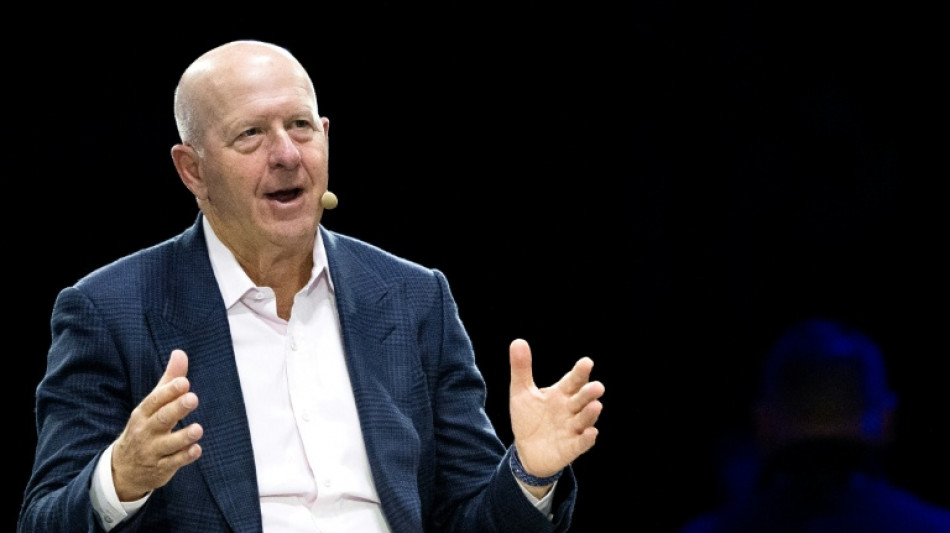
Goldman Sachs eyes more corporate mergers despite war uncertainty / Photo: © AFP/File

 London
 9 °C
9 °C

 Manchester
 9 °C
9 °C
 Glasgow
8 °C
Glasgow
8 °C
 Dublin
9 °C
Dublin
9 °C
 Belfast
 8 °C
8 °C
 Washington
18 °C
Washington
18 °C
 Denver
19 °C
Denver
19 °C
 Atlanta
18 °C
Atlanta
18 °C
 Dallas
 25 °C
25 °C
 Houston Texas
24 °C
Houston Texas
24 °C
 New Orleans
19 °C
New Orleans
19 °C
 El Paso
25 °C
El Paso
25 °C
 Phoenix
25 °C
Phoenix
25 °C
 Los Angeles
23 °C
San Diego
Los Angeles
23 °C
San Diego
 22 °C
San Francisco
14 °C
Chicago
19 °C
Minneapolis
25 °C
Seattle
10 °C
Portland
10 °C
Salt Lake City
22 °C
Las Vegas
26 °C
Miami
28 °C
Jacksonville
25 °C
San Antonio
26 °C
Bermuda
25 °C
Nassau
15 °C
Iqaluit
-4 °C
Yellowknife
5 °C
Anchorage
9 °C
Fairbanks
4 °C
Barrow
0 °C
Calgary
22 °C
San Francisco
14 °C
Chicago
19 °C
Minneapolis
25 °C
Seattle
10 °C
Portland
10 °C
Salt Lake City
22 °C
Las Vegas
26 °C
Miami
28 °C
Jacksonville
25 °C
San Antonio
26 °C
Bermuda
25 °C
Nassau
15 °C
Iqaluit
-4 °C
Yellowknife
5 °C
Anchorage
9 °C
Fairbanks
4 °C
Barrow
0 °C
Calgary
 0 °C
Edmonton
15 °C
Winnipeg
13 °C
Goose Bay
11 °C
Halifax
7 °C
Boston
9 °C
Ottawa
8 °C
Toronto
12 °C
Detroit
17 °C
Cleveland
16 °C
New York
16 °C
Baltimore
18 °C
Philadelphia
16 °C
Nuuk (Godthåb)
0 °C
Hong Kong
0 °C
Edmonton
15 °C
Winnipeg
13 °C
Goose Bay
11 °C
Halifax
7 °C
Boston
9 °C
Ottawa
8 °C
Toronto
12 °C
Detroit
17 °C
Cleveland
16 °C
New York
16 °C
Baltimore
18 °C
Philadelphia
16 °C
Nuuk (Godthåb)
0 °C
Hong Kong
 30 °C
Singapore
30 °C
Singapore
 31 °C
Melbourne
26 °C
Canberra
31 °C
Melbourne
26 °C
Canberra
 23 °C
Adelaide
27 °C
Darwin
34 °C
Perth
18 °C
Fort Worth
24 °C
Honolulu
23 °C
Adelaide
27 °C
Darwin
34 °C
Perth
18 °C
Fort Worth
24 °C
Honolulu
 27 °C
Sydney
25 °C
Johannesburg
13 °C
Dubai
30 °C
Mumbai
33 °C
Zürich
10 °C
Tokyo
26 °C
Seoul
27 °C
Delhi
28 °C
Beijing
22 °C
Riyadh
27 °C
Prague
8 °C
Pennsylvania
16 °C
Valletta
21 °C
Manama
31 °C
Warsaw
11 °C
Stockholm
8 °C
27 °C
Sydney
25 °C
Johannesburg
13 °C
Dubai
30 °C
Mumbai
33 °C
Zürich
10 °C
Tokyo
26 °C
Seoul
27 °C
Delhi
28 °C
Beijing
22 °C
Riyadh
27 °C
Prague
8 °C
Pennsylvania
16 °C
Valletta
21 °C
Manama
31 °C
Warsaw
11 °C
Stockholm
8 °C
Goldman Sachs reported strong first-quarter earnings on Monday, pointing to continued client interest in dealmaking that so far has not been derailed by the Middle East War.
The New York-based investment bank scored an 18 percent jump in quarterly profit to $5.4 billion, citing a "significant increase in completed mergers and acquisitions volumes" that boosted financial advisory revenues.
Overall revenues rose 14 percent to $17.2 billion.
While the "level of uncertainty is higher" due to the war, Chief Executive David Solomon told analysts that clients remain interested in large deals.
"We continue to see significant activity on the M&A front," Solomon said in a conference call. "We don't see that slowing."
Solomon also expressed bullishness on winning business from upcoming initial public offerings that will proceed because "it's important for those businesses and for capital formation on those businesses," he predicted.
Solomon expressed confidence in Goldman's private credit business in response to analyst questions amid growing investor anxiety.
"We feel we're very well positioned," Solomon said, pointing to an inflow in the quarter in private credit."
But Solomon described the worry about private credit as unsurprising given that "this has been a very long credit cycle" without a recession where problems are exposed.
"So when you do have cycle turn in a recession, we'll see higher losses across the space than you would have had if it was a shorter cycle," he said.
- Political opportunity for deals -
Monday's batch of results marked the third in a row in which Goldman flagged completed deals as a positive driver. Investment banking fees surged 48 percent in the quarter amid the strong mergers and acquisitions (M&A) flow.
The firm also saw an uptick in operating expenses in the period, partly due to the M&A surge. The presentation alluded to "significantly higher transaction-based expenses."
Revenues fell for fixed income, currency and commodities due to weakness in interest rate products and some other categories. However, this was partially offset by increases in commodities and currencies.
Revenues also rose in equities trading.
Increased volatility usually translates into higher trading revenues for Goldman.
Since US and Israeli forces attacked Iran on February 28, the surge in oil prices has dominated financial markets, often dictating trading dynamics in equities and other assets.
Solomon reiterated that CEOs from large view the current period as a window of opportunity to executive major deals under President Donald Trump's administration after the preceding Biden administration took a highly skeptical view of industry consolidation.
"As I talk to CEOs, of course they're watching what's going on geopolitically, but that's also balanced by the fact they see an opportunity during this period of time to drive scale and scale creation in businesses," Solomon said. "And that candidly trumps the geopolitical risk."
Goldman shares, which had risen more than 11 percent between late March and last Friday, fell 3.5 percent in late-morning trading.
I.Wright--SFF