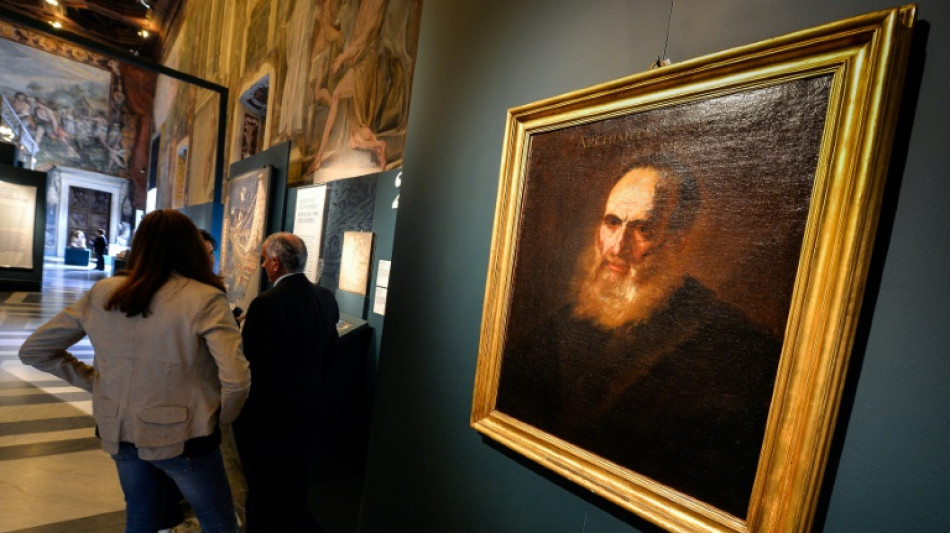
Lost page of legendary Archimedes palimpsest found in France / Photo: © AFP/File

 London
 21 °C
21 °C

 Manchester
 16 °C
16 °C
 Glasgow
 16 °C
16 °C
 Dublin
15 °C
Dublin
15 °C
 Belfast
 14 °C
14 °C
 Washington
 16 °C
16 °C
 Denver
15 °C
Denver
15 °C
 Atlanta
18 °C
Atlanta
18 °C
 Dallas
27 °C
Dallas
27 °C
 Houston Texas
27 °C
Houston Texas
27 °C
 New Orleans
24 °C
New Orleans
24 °C
 El Paso
18 °C
El Paso
18 °C
 Phoenix
22 °C
Phoenix
22 °C
 Los Angeles
20 °C
San Diego
21 °C
San Francisco
16 °C
Chicago
21 °C
Minneapolis
17 °C
Seattle
12 °C
Portland
16 °C
Salt Lake City
14 °C
Las Vegas
Los Angeles
20 °C
San Diego
21 °C
San Francisco
16 °C
Chicago
21 °C
Minneapolis
17 °C
Seattle
12 °C
Portland
16 °C
Salt Lake City
14 °C
Las Vegas
 23 °C
Miami
23 °C
Miami
 25 °C
Jacksonville
22 °C
San Antonio
27 °C
Bermuda
25 °C
Nassau
17 °C
Iqaluit
3 °C
Yellowknife
2 °C
Anchorage
6 °C
Fairbanks
1 °C
Barrow
-1 °C
Calgary
9 °C
Edmonton
15 °C
Winnipeg
12 °C
Goose Bay
11 °C
Halifax
15 °C
Boston
16 °C
Ottawa
11 °C
Toronto
15 °C
Detroit
16 °C
Cleveland
25 °C
Jacksonville
22 °C
San Antonio
27 °C
Bermuda
25 °C
Nassau
17 °C
Iqaluit
3 °C
Yellowknife
2 °C
Anchorage
6 °C
Fairbanks
1 °C
Barrow
-1 °C
Calgary
9 °C
Edmonton
15 °C
Winnipeg
12 °C
Goose Bay
11 °C
Halifax
15 °C
Boston
16 °C
Ottawa
11 °C
Toronto
15 °C
Detroit
16 °C
Cleveland
 16 °C
New York
17 °C
Baltimore
17 °C
Philadelphia
18 °C
Nuuk (Godthåb)
1 °C
Hong Kong
34 °C
Singapore
27 °C
Melbourne
24 °C
Canberra
20 °C
Adelaide
21 °C
Darwin
30 °C
Perth
18 °C
Fort Worth
27 °C
Honolulu
26 °C
Sydney
21 °C
Johannesburg
8 °C
Dubai
38 °C
Mumbai
16 °C
New York
17 °C
Baltimore
17 °C
Philadelphia
18 °C
Nuuk (Godthåb)
1 °C
Hong Kong
34 °C
Singapore
27 °C
Melbourne
24 °C
Canberra
20 °C
Adelaide
21 °C
Darwin
30 °C
Perth
18 °C
Fort Worth
27 °C
Honolulu
26 °C
Sydney
21 °C
Johannesburg
8 °C
Dubai
38 °C
Mumbai
 31 °C
Zürich
19 °C
Tokyo
19 °C
Seoul
25 °C
Delhi
33 °C
Beijing
20 °C
Riyadh
37 °C
Prague
15 °C
Pennsylvania
18 °C
Valletta
25 °C
Manama
37 °C
Warsaw
15 °C
Stockholm
12 °C
31 °C
Zürich
19 °C
Tokyo
19 °C
Seoul
25 °C
Delhi
33 °C
Beijing
20 °C
Riyadh
37 °C
Prague
15 °C
Pennsylvania
18 °C
Valletta
25 °C
Manama
37 °C
Warsaw
15 °C
Stockholm
12 °C
It all started off as a joke, a French researcher told AFP.
But what the team found was a piece of history -- a long-lost page from a legendary manuscript by ancient Greek mathematician Archimedes which had been languishing, forgotten, in the archives of a French museum.
Archimedes, considered one of history's greatest mathematicians and inventors, lived in the third century BC in the city of Syracuse.
Among his many discoveries was the principle of buoyancy, which he struck while stepping out of a bath -- famously prompting him to shout "Eureka!".
This treatise and many others of his lasted down through the centuries on a manuscript called a palimpsest, which changed hands many times.
A palimpsest is a handwritten parchment that has had its original text scraped off before being written over, sometimes several times.
Victor Gysembergh, the researcher at France's CNRS research centre who found the missing page of Archimedes's palimpsest, told AFP it was a "treasure trove of lost texts from antiquity".
As well as Archimedes's mathematical breakthroughs, the manuscript contains his "philosophical, literary and religious" writings, Gysembergh enthused.
The palimpsest itself was not written by Archimedes's hand but was instead copied during the 900s AD.
Around two centuries later, the text was erased and re-used as a Christian prayer book.
- From Constantinople to Bezos? -
That was just the beginning of the journey for this unique manuscript, whose fate followed the twists and turns of history.
By the 1800s, it was held by the Greek Orthodox Patriarchate of Jerusalem, including inside a library in Constantinople, modern-day Istanbul.
Danish historian Johan Ludvig Heiberg found the palimpsest there -- and took photographs of every page in 1906.
However, at some point during World War I, the document vanished without a trace.
It somehow wound up in the private collection of a French family, which eventually put it up for auction in 1998.
It was purchased by an anonymous Western businessman.
Insiders quoted by Germany's Der Spiegel newspaper claimed it was Amazon billionaire Jeff Bezos, although the true identity remains unknown.
But three of the palimpsest's 177 pages had disappeared.
This is where Gysembergh comes in.
"I am interested in palimpsests because they are a way to discover lost texts," said the lead author of a study in the German Journal of Papyrology and Epigraphy.
Sometimes Gysembergh searches for palimpsests in the libraries of different cities for fun.
The lost Archimedes's page was discovered "due in part to a joke", he said.
One day he was chatting with his office colleagues, when he mentioned that the old kings of France had kept part of their library in the central French city of Blois.
"Hey, let's see if there's a palimpsest in Blois," he told his colleagues.
- 'Very unexpected' -
Gysembergh was astonished to find a hit on Arca -- an online catalogue of digitised manuscripts -- in the city's museum of fine art.
"It was very unexpected to stumble upon a Greek manuscript," Gysembergh said.
"And even more so to find a 10th-century scientific treatise!"
The researcher then compared the pages to the photos of Archimedes's palimpsest taken in 1906.
The handwriting, the geometric figures, even the errors all perfectly matched, he said.
One side of the page contains Archimedes's treatise "On the sphere and the cylinder", which was the first time the surface area of a sphere and its volume were described in such detail.
On the other side is a newer drawing, which is thought to have been added in the 1900s in an attempt to increase the document's value.
To decipher the text below the drawing, Gysembergh hopes to carry out high-tech analysis -- such as multispectral imaging and X-ray fluorescence -- in the coming year.
He also hopes that this breakthrough will help find the other two missing pages of the palimpsest.
"Until this discovery, we had no reason to hope we would ever find them," he said.
"Now, if institutions or private collectors have this kind of manuscript, they should think about whether it could be one of the other lost pages."
M.Hill--SFF