Raul Castro: the other leader of Cuba's revolution / Photo: © AFP

 London
 17 °C
17 °C
 Manchester
17 °C
Manchester
17 °C
 Glasgow
 7 °C
7 °C
 Dublin
17 °C
Dublin
17 °C
 Belfast
16 °C
Belfast
16 °C
 Washington
24 °C
Washington
24 °C
 Denver
 27 °C
27 °C
 Atlanta
 28 °C
28 °C
 Dallas
 31 °C
31 °C
 Houston Texas
31 °C
Houston Texas
31 °C
 New Orleans
31 °C
New Orleans
31 °C
 El Paso
29 °C
El Paso
29 °C
 Phoenix
27 °C
Phoenix
27 °C
 Los Angeles
19 °C
San Diego
21 °C
San Francisco
18 °C
Chicago
31 °C
Minneapolis
26 °C
Seattle
15 °C
Portland
15 °C
Salt Lake City
Los Angeles
19 °C
San Diego
21 °C
San Francisco
18 °C
Chicago
31 °C
Minneapolis
26 °C
Seattle
15 °C
Portland
15 °C
Salt Lake City
 10 °C
Las Vegas
22 °C
Miami
30 °C
Jacksonville
31 °C
San Antonio
32 °C
Bermuda
28 °C
Nassau
22 °C
Iqaluit
0 °C
Yellowknife
8 °C
Anchorage
7 °C
Fairbanks
3 °C
Barrow
-3 °C
Calgary
6 °C
Edmonton
31 °C
Winnipeg
6 °C
Goose Bay
15 °C
Halifax
20 °C
Boston
22 °C
Ottawa
16 °C
Toronto
22 °C
Detroit
26 °C
Cleveland
26 °C
New York
22 °C
Baltimore
24 °C
Philadelphia
22 °C
Nuuk (Godthåb)
4 °C
Hong Kong
10 °C
Las Vegas
22 °C
Miami
30 °C
Jacksonville
31 °C
San Antonio
32 °C
Bermuda
28 °C
Nassau
22 °C
Iqaluit
0 °C
Yellowknife
8 °C
Anchorage
7 °C
Fairbanks
3 °C
Barrow
-3 °C
Calgary
6 °C
Edmonton
31 °C
Winnipeg
6 °C
Goose Bay
15 °C
Halifax
20 °C
Boston
22 °C
Ottawa
16 °C
Toronto
22 °C
Detroit
26 °C
Cleveland
26 °C
New York
22 °C
Baltimore
24 °C
Philadelphia
22 °C
Nuuk (Godthåb)
4 °C
Hong Kong
 26 °C
Singapore
27 °C
Melbourne
29 °C
Canberra
14 °C
Adelaide
11 °C
Darwin
26 °C
Perth
13 °C
Fort Worth
30 °C
Honolulu
29 °C
Sydney
19 °C
Johannesburg
14 °C
Dubai
32 °C
Mumbai
32 °C
Zürich
9 °C
Tokyo
19 °C
Seoul
26 °C
Singapore
27 °C
Melbourne
29 °C
Canberra
14 °C
Adelaide
11 °C
Darwin
26 °C
Perth
13 °C
Fort Worth
30 °C
Honolulu
29 °C
Sydney
19 °C
Johannesburg
14 °C
Dubai
32 °C
Mumbai
32 °C
Zürich
9 °C
Tokyo
19 °C
Seoul
 19 °C
Delhi
23 °C
Beijing
12 °C
Riyadh
31 °C
Prague
8 °C
Pennsylvania
21 °C
Valletta
24 °C
Manama
19 °C
Delhi
23 °C
Beijing
12 °C
Riyadh
31 °C
Prague
8 °C
Pennsylvania
21 °C
Valletta
24 °C
Manama
 32 °C
Warsaw
9 °C
Stockholm
7 °C
32 °C
Warsaw
9 °C
Stockholm
7 °C
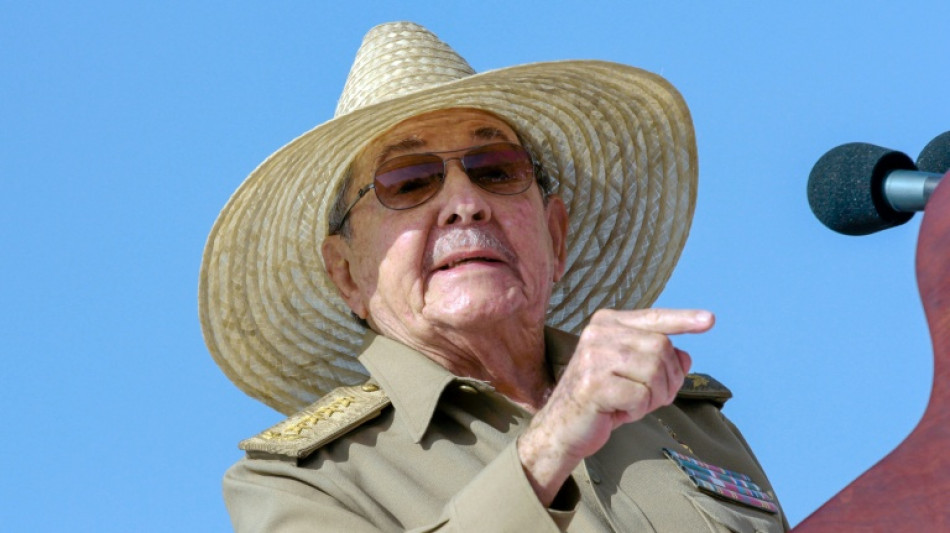
Raul Castro, the younger brother of Fidel Castro and the last surviving cast member of the Cuban revolution, relinquished power in 2021 but remains an influential figure in national politics.
In a further spike in US-Cuba tensions, a court in Florida on Wednesday unsealed an indictment against the 94-year-old and charged him with conspiracy to kill US nationals, four counts of murder and two counts of destroying aircraft.
The charges relate to the downing of US civilian planes by Cuban forces on February 24, 1996.
Raul lived for decades in brother Fidel's shadow before emerging as a pragmatic leader who initiated much-needed reforms in Cuba without ever abandoning allegiance to the one-party state.
The revolutionary leader still follows Washington-Havana negotiations "very closely" and takes part in "decision-making," his daughter Mariela Castro told AFP in April.
- Brothers in arms -
Raul took over from Fidel in 2006 and led the communist island-nation for the next 15 years.
He still makes occasional public appearances, increasingly frail but always dressed in his military uniform.
During the most recent on May 1, at a rally in front of the US embassy in Havana, he had to sit down before the ceremony's conclusion.
Castro was born on June 3, 1931 in a village in eastern Cuba, the fourth of seven children raised by a Spanish father, Angel Castro, and a Cuban mother, Lina Ruz.
Aged 22, with no military experience, he joined big brother Fidel in an attack on a garrison in a failed attempt to topple dictator Fulgencio Batista.
The siblings spent two years in prison before leaving together for exile in Mexico to plan Batista's final ouster.
The Castros returned home in December 1956 aboard the "Granma" yacht, loaded with rebels for the start of a guerrilla campaign.
When the revolution triumphed in January 1959, Raul Castro became second-in-command to Fidel.
- 'Brutal' -
The younger Castro gained a reputation as an organizer and administrator, but those in the know also describe him as an uncompromising hardliner.
"As brutal or more brutal than Fidel Castro," Brian Latell, a former US Central Intelligence Agency analyst, had said of Raul.
With his troops, Rahul showed a different side.
"He liked to chat, to joke and have a drink with his officers...there was something about him his soldiers liked," Hal Klepak, professor emeritus of history and strategy at the Royal Military College in Canada, told AFP.
As minister of defense for five decades, Castro shaped Cuba's Revolutionary Armed Forces (FAR) into a fighting force focused on repelling a potential US invasion.
He allocated substantial funds for the purpose, a strategy credited with helping the Communist Party of Cuba (PCC) survive after the fall of the Soviet Union -- a key ally and funder -- in 1991.
During this time, Cuban Air Force MiG fighters downed two planes belonging to a Cuban-American exile group.
Four members of the Miami-based anti-Castro humanitarian group, "Brothers to the Rescue," were killed, and their bodies were never found.
That incident in 1996 was behind Wednesday's indictment.
- 'Perfecting socialism' -
Taking over from his ailing brother in an acting capacity in 2006, Castro became president two years later and leader of the PCC in 2011.
He launched unprecedented reforms, opening the single-party state's economy to the private sector.
The leader also authorized Cubans to travel abroad, to sell cars or homes, and he even freed some jailed dissidents.
Critics said he never went far, but Castro himself had said he was "elected to defend, maintain and continue perfecting socialism -- not to destroy it."
Alongside then-US president Barack Obama, Castro was credited with negotiating a previously unthinkable rapprochement with the United States only for Donald Trump to rip it up during his first term.
Castro entered semi-retirement in 2018, giving up the presidency for a younger generation embodied by new leader Miguel Diaz-Canel.
Three years later, he also gave up the leadership of the Cuban communist party, where the real power lies.
A family man unlike Fidel, Raul married fellow revolutionary Vilma Espin, with whom he had four children. She died in 2007.
F.Garcia--SFF