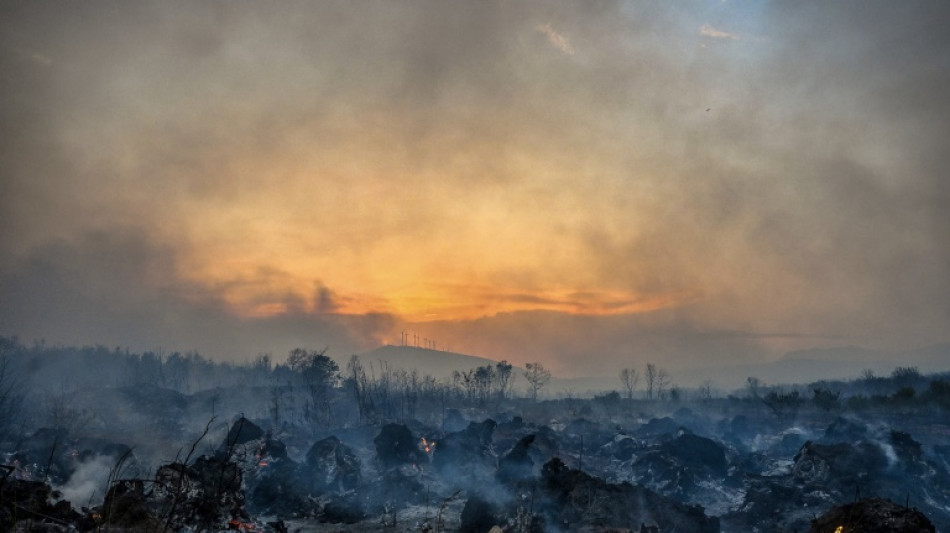
Greenhouse gas levels hit new record highs in 2025: UN / Photo: © AFP

 London
 15 °C

 Manchester
 13 °C
 Glasgow
 15 °C
 Dublin
 12 °C
 Belfast
12 °C
 Washington
13 °C
 Denver
4 °C
 Atlanta
 10 °C
 Dallas
18 °C
 Houston Texas
20 °C
 New Orleans
 18 °C
 El Paso
 16 °C
 Phoenix
 19 °C
 Los Angeles
16 °C
San Diego
16 °C
San Francisco
 13 °C
Chicago
13 °C
Minneapolis
7 °C
Seattle
10 °C
Portland
 11 °C
Salt Lake City
6 °C
Las Vegas
14 °C
Miami
25 °C
Jacksonville
19 °C
San Antonio
19 °C
Bermuda
23 °C
Nassau
12 °C
Iqaluit
-9 °C
Yellowknife
-5 °C
Anchorage
2 °C
Fairbanks
1 °C
Barrow
-2 °C
Calgary
0 °C
Edmonton
8 °C
Winnipeg
-3 °C
Goose Bay
2 °C
Halifax
9 °C
Boston
8 °C
Ottawa
1 °C
Toronto
4 °C
Detroit
9 °C
Cleveland
9 °C
New York
12 °C
Baltimore
13 °C
Philadelphia
12 °C
Nuuk (Godthåb)
-3 °C
Hong Kong
26 °C
Singapore
30 °C
Melbourne
25 °C
Canberra
7 °C
Adelaide
12 °C
Darwin
27 °C
Perth
20 °C
Fort Worth
17 °C
Honolulu
23 °C
Sydney
16 °C
Johannesburg
29 °C
Dubai
33 °C
Mumbai
32 °C
Zürich
18 °C
Tokyo
20 °C
Seoul
8 °C
Delhi
28 °C
Beijing
5 °C
Riyadh
35 °C
Prague
14 °C
Pennsylvania
12 °C
Valletta
22 °C
Manama
33 °C
Warsaw
12 °C
Stockholm
 10 °C
Greenhouse gas concentrations in the atmosphere rose to new record highs in 2025, locking in climate impacts that will persist for centuries to come, the United Nations said Tuesday.
Levels of the three main greenhouse gases -- the climate-warming carbon dioxide, methane and nitrous oxide -- all rose to unprecedented figures in 2025, the UN's weather and climate agency said.
The World Meteorological Organization said the rise would lead to more long-term temperature increases for the planet.
The WMO's 22nd annual Greenhouse Gas Bulletin comes ahead of the COP31 UN climate summit in Antalya, Turkey, running from November 9 to 20.
"Another year, another new record," said WMO deputy secretary-general Ko Barrett.
"Greenhouse gases are trapping an unprecedented amount of heat in the atmosphere, providing energy for more extreme weather and associated risks to our economies and societies.
"The past 11 years have been the warmest on record and this trend is set to continue. Carbon dioxide (CO2) has a very long life-time and so will affect the global climate not just for years but for decades and even centuries."
- El Nino effect -
The bulletin looks at greenhouse gas concentrations -- the amount of those gases in the atmosphere -- rather than new annual emissions amounts as the world burns more coal, oil and gas.
In 2025, carbon dioxide concentrations were at 426.8 parts per million (ppm); methane at 1,948 parts per billion, and nitrous oxide at 339.1 parts per billion.
That takes them respectively to 153 percent, 267 percent and 126 percent of the pre-industrial levels witnessed before 1750.
Of the three major greenhouse gases, CO2 accounts for about 66 percent of the warming effect on the climate.
Around half of the total CO2 emitted each year remains in the atmosphere; the rest is absorbed by the land and oceans.
From 2024 to 2025, the global average concentration of CO2 rose by 2.8 ppm -- smaller than the record surge from 2023 to 2024 of 3.6 ppm.
WMO senior scientific officer Oksana Tarasova said this reflected the "recovery of the land carbon sinks and reduced fire carbon emissions in 2025 after the strong 2023/2024 El Nino", the naturally-occurring, climate-warming weather phenomenon.
"However, a 2.8 ppm annual increase is still a substantial addition of carbon to the atmosphere from fossil fuel burning."
It is also above the average growth rate over the past decade of 2.6 ppm -- a figure that stood at 0.8 ppm in the 1960s.
Monitoring station data shows that that CO2 levels have continued rising in 2026.
"Every additional part per million matters because it traps additional heat," Barrett told reporters.
"In effect, we are supercharging the ocean and the atmosphere. That means that heatwaves, tropical cyclones, and rainstorms are intensifying faster than our historical baselines prepared us for."
- Growing concerns over H2, SF6 -
Methane accounts for about 16 percent of the warming effect on the climate by long-lived greenhouse gases, though it has a much shorter lifetime than CO2.
Around a third of methane emitted into the atmosphere comes from natural sources like wetlands, with the rest from anthropogenic sources such as cattle, rice farming, landfills and biomass burning.
The bulletin said that as countries shift their energy systems towards decarbonisation, more attention should be paid to two potent but less abundant trace gases closely related to electricity production and distribution: molecular hydrogen (H2) and sulfur hexafluoride (SF6).
Primarily as a spark suppressant in electricity distribution, SF6 has been rising steadily over the past three decades.
"Why should we be concerned? Because SF6 has an atmospheric lifetime of up to 3,200 years. Its global warming potential is more than 24,000 times that of CO2," Barrett told reporters.
Why H2 levels have increased over the past decade is unknown but it has begun to be used as an energy storage medium.
T.Rivera--SFF