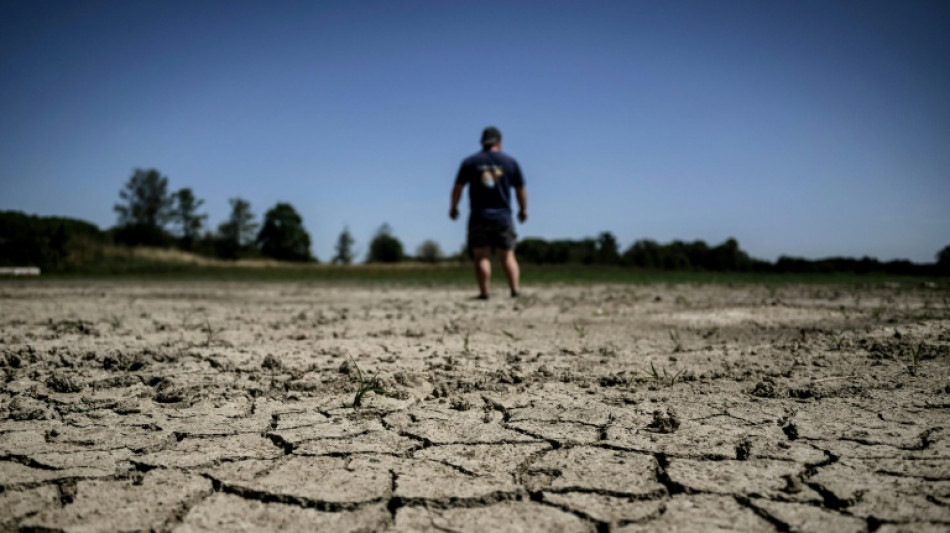
French pair propose new term to define 'environment' / Photo: © AFP/File

 London
 12 °C
12 °C

 Manchester
 11 °C
11 °C
 Glasgow
 12 °C
12 °C
 Dublin
 10 °C
10 °C
 Belfast
10 °C
Belfast
10 °C
 Washington
17 °C
Washington
17 °C
 Denver
9 °C
Denver
9 °C
 Atlanta
19 °C
Atlanta
19 °C
 Dallas
24 °C
Dallas
24 °C
 Houston Texas
26 °C
Houston Texas
26 °C
 New Orleans
23 °C
New Orleans
23 °C
 El Paso
19 °C
El Paso
19 °C
 Phoenix
21 °C
Phoenix
21 °C
 Los Angeles
22 °C
San Diego
21 °C
San Francisco
16 °C
Chicago
21 °C
Minneapolis
11 °C
Seattle
Los Angeles
22 °C
San Diego
21 °C
San Francisco
16 °C
Chicago
21 °C
Minneapolis
11 °C
Seattle
 9 °C
Portland
9 °C
Salt Lake City
12 °C
Las Vegas
17 °C
Miami
27 °C
Jacksonville
21 °C
San Antonio
24 °C
Bermuda
22 °C
Nassau
17 °C
Iqaluit
-4 °C
Yellowknife
-5 °C
Anchorage
9 °C
Portland
9 °C
Salt Lake City
12 °C
Las Vegas
17 °C
Miami
27 °C
Jacksonville
21 °C
San Antonio
24 °C
Bermuda
22 °C
Nassau
17 °C
Iqaluit
-4 °C
Yellowknife
-5 °C
Anchorage
 3 °C
Fairbanks
3 °C
Fairbanks
 -2 °C
Barrow
-1 °C
Calgary
-2 °C
Edmonton
21 °C
Winnipeg
5 °C
Goose Bay
15 °C
Halifax
17 °C
Boston
17 °C
Ottawa
15 °C
Toronto
16 °C
Detroit
18 °C
Cleveland
18 °C
New York
18 °C
Baltimore
17 °C
Philadelphia
17 °C
Nuuk (Godthåb)
-5 °C
Hong Kong
26 °C
Singapore
25 °C
Melbourne
27 °C
Canberra
12 °C
Adelaide
-2 °C
Barrow
-1 °C
Calgary
-2 °C
Edmonton
21 °C
Winnipeg
5 °C
Goose Bay
15 °C
Halifax
17 °C
Boston
17 °C
Ottawa
15 °C
Toronto
16 °C
Detroit
18 °C
Cleveland
18 °C
New York
18 °C
Baltimore
17 °C
Philadelphia
17 °C
Nuuk (Godthåb)
-5 °C
Hong Kong
26 °C
Singapore
25 °C
Melbourne
27 °C
Canberra
12 °C
Adelaide
 8 °C
Darwin
29 °C
Perth
13 °C
Fort Worth
24 °C
Honolulu
23 °C
Sydney
21 °C
Johannesburg
25 °C
Dubai
33 °C
Mumbai
8 °C
Darwin
29 °C
Perth
13 °C
Fort Worth
24 °C
Honolulu
23 °C
Sydney
21 °C
Johannesburg
25 °C
Dubai
33 °C
Mumbai
 32 °C
Zürich
9 °C
Tokyo
32 °C
Zürich
9 °C
Tokyo
 20 °C
Seoul
18 °C
Delhi
22 °C
Beijing
9 °C
Riyadh
31 °C
Prague
11 °C
Pennsylvania
15 °C
Valletta
20 °C
Seoul
18 °C
Delhi
22 °C
Beijing
9 °C
Riyadh
31 °C
Prague
11 °C
Pennsylvania
15 °C
Valletta
 20 °C
Manama
32 °C
Warsaw
12 °C
Stockholm
8 °C
20 °C
Manama
32 °C
Warsaw
12 °C
Stockholm
8 °C
Environmental causes face an uphill battle. Overshadowed in politics, overlooked in budgets and defeated in courts, nature is often treated as a niche concern, second to more pressing matters.
Two Frenchmen -- one a philosopher, the other a legal scholar -- think language is part of the problem and argue that protection of the living world should be discussed in entirely different legal terms.
In their new book, Baptiste Morizot and Laurent Neyret make the case that "habitability" -- the conditions that support human life on Earth -- should be treated as a fundamental right like dignity and liberty.
"Habitability is the condition of all our rights and freedoms," Morizot, a researcher at Aix-Marseille University, told AFP.
Even in France where the environment holds constitutional status, Morizot said the defence of nature as a basic right is often relegated below other core values even if people do not realise it.
"No one has said we should talk about the environment as if it were secondary," the philosopher said. But "it is marginalised; it is not in the realm of importance".
- Marginalised -
Morizot and Neyret searched for a term that elevated the environment to a fundamental condition of humanity's existence rather than a backdrop to be protected when convenient.
"This word exists. It is habitability," they wrote in "Liberté, Dignité, Habitabilité", the French title of their book published in April which is yet to be translated into English.
The framework of environmental law, the authors write, dates from a time when humans did not yet have the technological capacity to drastically alter Earth's habitability or its climate.
Morizot says "the environment" has become more broadly associated with nature and "people who like flowers and little birds."
"But security is more important, health is more important, growth is more important," he said of the prevailing attitude.
If judges regarded habitability in the same way as liberty then "restrictions on applying pesticides near groundwater would no longer be seen as an arbitrary burden, but as the result of a value recognised by all", the authors wrote.
The concept "prohibits the law from continuing to speak as if the world were an unchanging environment."
- 'Underground movement' -
Even as environmental protection has slipped down the policy priority list in the United States and Europe, climate activists have scored major courtroom wins recently from the International Court of Justice to national tribunals.
"We are facing a movement where habitability is on the verge of being taken seriously in courtrooms, and where even those who don't want to play along can't opt out," co-author Neyret told AFP.
"By naming habitability, we hope to surface this underground movement, accelerate and amplify it," said the former chief of staff to French Constitutional Council president Laurent Fabius.
The authors acknowledge the widespread adoption of such a term could take years or decades. When will we know that habitability is considered a core value?
"When it is cited in court rulings by judges, when it is enshrined in the constitution... in France or elsewhere, when it appears in the preambles of international declarations," said Morizot.
And above all: "When it enables a judge to tip a case one way or the other," he said.
W.Carter--SFF