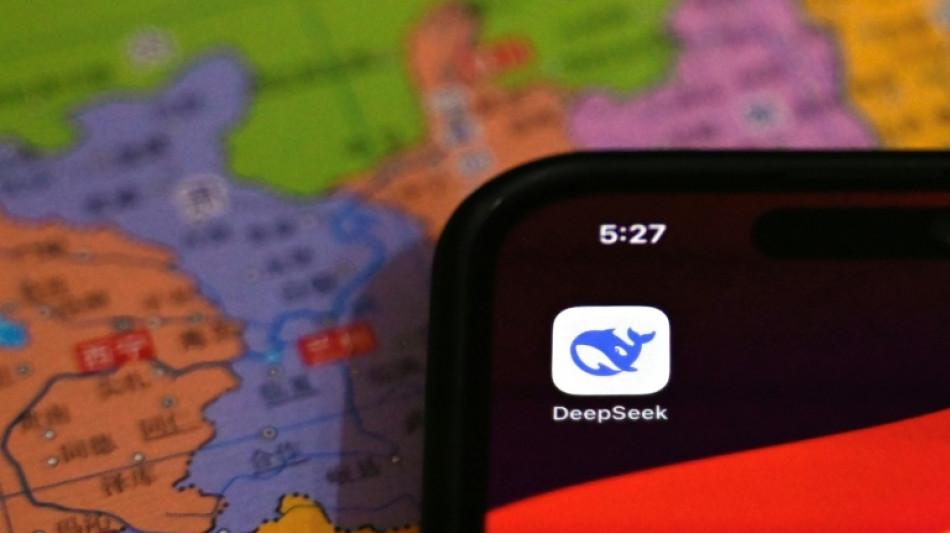
Inside China's buzzing AI scene year after DeepSeek shock / Photo: © AFP/File

 London
 13 °C
13 °C

 Manchester
13 °C
Manchester
13 °C
 Glasgow
 3 °C
3 °C
 Dublin
15 °C
Dublin
15 °C
 Belfast
14 °C
Belfast
14 °C
 Washington
17 °C
Washington
17 °C
 Denver
 20 °C
20 °C
 Atlanta
16 °C
Atlanta
16 °C
 Dallas
24 °C
Dallas
24 °C
 Houston Texas
25 °C
Houston Texas
25 °C
 New Orleans
21 °C
New Orleans
21 °C
 El Paso
 23 °C
23 °C
 Phoenix
23 °C
Phoenix
23 °C
 Los Angeles
18 °C
San Diego
Los Angeles
18 °C
San Diego
 17 °C
San Francisco
12 °C
Chicago
18 °C
Minneapolis
24 °C
Seattle
8 °C
Portland
8 °C
Salt Lake City
11 °C
Las Vegas
20 °C
Miami
27 °C
Jacksonville
21 °C
San Antonio
24 °C
Bermuda
26 °C
Nassau
12 °C
Iqaluit
17 °C
San Francisco
12 °C
Chicago
18 °C
Minneapolis
24 °C
Seattle
8 °C
Portland
8 °C
Salt Lake City
11 °C
Las Vegas
20 °C
Miami
27 °C
Jacksonville
21 °C
San Antonio
24 °C
Bermuda
26 °C
Nassau
12 °C
Iqaluit
 -5 °C
Yellowknife
6 °C
Anchorage
6 °C
Fairbanks
-5 °C
Yellowknife
6 °C
Anchorage
6 °C
Fairbanks
 2 °C
Barrow
-1 °C
Calgary
-1 °C
Edmonton
14 °C
Winnipeg
6 °C
Goose Bay
12 °C
Halifax
13 °C
Boston
11 °C
Ottawa
13 °C
Toronto
14 °C
Detroit
16 °C
Cleveland
17 °C
New York
13 °C
Baltimore
16 °C
Philadelphia
13 °C
Nuuk (Godthåb)
0 °C
Hong Kong
30 °C
Singapore
33 °C
Melbourne
24 °C
Canberra
2 °C
Barrow
-1 °C
Calgary
-1 °C
Edmonton
14 °C
Winnipeg
6 °C
Goose Bay
12 °C
Halifax
13 °C
Boston
11 °C
Ottawa
13 °C
Toronto
14 °C
Detroit
16 °C
Cleveland
17 °C
New York
13 °C
Baltimore
16 °C
Philadelphia
13 °C
Nuuk (Godthåb)
0 °C
Hong Kong
30 °C
Singapore
33 °C
Melbourne
24 °C
Canberra
 23 °C
Adelaide
16 °C
Darwin
34 °C
Perth
23 °C
Adelaide
16 °C
Darwin
34 °C
Perth
 22 °C
Fort Worth
24 °C
Honolulu
25 °C
Sydney
32 °C
Johannesburg
19 °C
Dubai
35 °C
Mumbai
36 °C
Zürich
22 °C
Fort Worth
24 °C
Honolulu
25 °C
Sydney
32 °C
Johannesburg
19 °C
Dubai
35 °C
Mumbai
36 °C
Zürich
 7 °C
Tokyo
26 °C
Seoul
28 °C
Delhi
25 °C
Beijing
20 °C
Riyadh
33 °C
Prague
7 °C
Pennsylvania
14 °C
Valletta
23 °C
Manama
34 °C
Warsaw
7 °C
Stockholm
9 °C
7 °C
Tokyo
26 °C
Seoul
28 °C
Delhi
25 °C
Beijing
20 °C
Riyadh
33 °C
Prague
7 °C
Pennsylvania
14 °C
Valletta
23 °C
Manama
34 °C
Warsaw
7 °C
Stockholm
9 °C
Before DeepSeek shook up the tech world and put Chinese artificial intelligence on the map, Wu Chenglin's own startup had nearly folded three times -- but in the past year it has raised $30 million.
The January 2025 release of a low-cost generative AI model from DeepSeek that performed at a similar level to ChatGPT and other top American chatbots upended assumptions of US dominance in the sensitive sector.
The breakthrough has galvanised China's AI scene, despite hurdles posed by rivalry with the United States, and fears of a global market bubble.
"It gave a lot of people confidence" that China's AI community previously lacked, Wu told AFP.
His venture DeepWisdom, whose flagship product is a platform for AI-powered software development, had struggled to stay afloat despite its popularity among programmers.
But as excitement around DeepSeek fuelled a boom in spending, Wu raised 220 million yuan in two funding rounds.
Meanwhile, Shi Yaqiong and her team at Beijing-based Jinqiu Capital have closed deals with more than 50 AI firms over the past 12 months.
Shi, the fund's vice-president, described a "clear surge" in enthusiasm around Chinese AI and competition among investors since the DeepSeek shock.
"The kind of projects with an initial valuation in 2024 of $10-20 million were, in 2025, expected to have initial valuations around $20-40 million," she said.
- Engineer dividend -
Shares in two leading Chinese AI startups, Zhipu AI and MiniMax, soared on their market debuts in Hong Kong this month.
Frenzy over the much-hyped potential of AI to change the world is driving global stocks to record highs, led by chipmakers and tech giants.
But the big-spending euphoria has sparked fears of a market crash, with many investors hyper-focused on any sign the AI bubble could burst, and questioning when new companies will become profitable.
Access to top-end chips made by US giant Nvidia is also restricted in China under White House policies designed to curb China's technological development.
But that hasn't dampened the spirits of young developers in the world's second largest economy.
At an AI networking event held on a brisk winter afternoon last week in a stylish Beijing cafe, animated discussion filled the air about the future of the fast-moving industry.
Chip export controls mean Chinese AI is more likely to be "open-source and cheap" which could make it more useful to society, said one participant, entrepreneur Li Weijia.
China is often said to enjoy an "engineer dividend" that benefits its AI sector, and talent is flocking to the field.
Online hiring platform Zhilian Zhaopin reported a 39 percent increase in applications to AI-related jobs in the first three quarters of 2025, after DeepSeek's breakout.
- 'Cost-efficient' -
"China has a huge application developer ecosystem and people are very good at building apps," Shen Qiajin, founder of ideaFlow, told AFP.
"But for a very long time, we didn't have a good cost-efficient model," he said.
That is a gap DeepSeek has now filled.
The firm began in 2023 as a side project of a data-driven hedge fund co-founded in the tech hub Hangzhou by Liang Wenfeng, which had access to a cache of powerful Nvidia processors.
Today, the company -- expected to release its next AI model within weeks -- holds four percent of global market share for chatbots, according to web traffic analysis company Similarweb.
ChatGPT dominates at 68 percent while Google's Gemini is catching up at 18 percent, Similarweb estimates.
DeepSeek's decision to make its systems' inner workings public, in contrast to the closed AI models sold by OpenAI and other Western rivals, has boosted adoption of its tools by developers and businesses, Neil Shah at Counterpoint Research said.
Its tools have had "strong adoption in cost-sensitive emerging markets", he said.
But in the West users are more cautious, "primarily on account of privacy and national security concerns".
Even so, the domestic market is huge. By June 2025, more than half a billion Chinese internet users reported having used generative AI products, according to the China Internet Network Information Center.
Entrepreneur Yang Yiwen said her parents had their first meaningful encounter with AI during last year's Chinese New Year, when they watched her use DeepSeek to plan a family trip.
"They found it quite fun," she said.
O.Green--SFF